ICES CRR 209 Compliance
Diesel generators rest on double-stage elastic rafts inside acoustic enclosures. Electric propulsion motors drive fixed-pitch five-bladed propellers designed to delay cavitation onset until 11+ knots in open water.
To sample the central Arctic Ocean in winter, a ship must simultaneously break two-metre pressure ridges and hold quiet enough in the water for a 12 kHz acoustic pulse to return from four kilometres below. Every structural decision on a polar research vessel balances ice-breaking force against scientific delicacy.
Sea ice has high compressive strength (often 3 to 5 MPa in multi-year floes) but comparatively weak flexural strength (0.5 to 1.0 MPa). Icebreakers do not cleave ice like a knife; their spoon-shaped or wedge-shaped bows ride up onto the ice edge at an stem angle of 20° to 28°, using the vessel’s displacement weight to bend the ice downward until it snaps in flexure.
Once broken, submerged ice blocks slide along the hull bottom. If those blocks pass across flush-mounted acoustic transducers, they shear off titanium windows or flood the receiver array with air bubbles. Modern vessels such as RV Sikuliaq and RV Kronprins Haakon incorporate an ice knife and flared forefoot that deflect broken floes outward, keeping a clear water channel along the keel centreline.
High-tensile EH36 and FH36 cold-tough steels prevent brittle fracture at ambient temperatures down to −40°C, while frame spacing in the bow ice belt narrows to 300–400 mm—less than half the spacing of a conventional open-ocean vessel.
The International Association of Classification Societies (IACS) defines seven Polar Classes (PC1 through PC7). Below are verifiable engineering specifications of active polar research platforms.
| Vessel Name | Ice Class | Length / Displacement | Icebreaking Capability | Primary Scientific Systems |
|---|---|---|---|---|
| RV Polarstern (AWI, Germany) | ARC3 (PC2 equiv.) | 118 m / 17,300 t | 1.5 m level ice at 5 knots | 9 wet/dry labs, moonpool, 10,000 m deep-sea winch |
| RV Kronprins Haakon (Norway) | IACS PC3 | 100 m / 9,000 t | 1.0 m level ice at 5 knots | 4×4 m moonpool, drop keel, ICES 209 silent propulsion |
| RRS Sir David Attenborough (BAS, UK) | IACS PC4 (PC5 stern) | 129 m / 15,000 t | 1.0 m level ice at 3 knots | 4×4 m moonpool, trace-metal clean winch, twin drop keels |
| USCGC Healy (WAGB-20, USA) | Medium Polar IB | 128 m / 16,000 t | 1.4 m level ice at 3 knots | EM122 multibeam, 4,200 sq ft lab space, A-frames |
| RV Sikuliaq (UAF / NSF, USA) | IACS PC5 | 80 m / 3,665 t | 0.8 m level ice at 2 knots | Centreboard sensor gondola, Baltic room side deployment |
Diesel generators rest on double-stage elastic rafts inside acoustic enclosures. Electric propulsion motors drive fixed-pitch five-bladed propellers designed to delay cavitation onset until 11+ knots in open water.
If a CTD rosette emerges from −1.8°C seawater into −30°C deck air, residual water inside conductivity cells freezes instantly, cracking the glass cell. Enclosed, heated staging hangars prevent thermal shock.
Standard open-water DP algorithms struggle when floes push intermittently against the hull. Polar DP combines azimuth thrusters with ice-drift radar tracking to weather-vane the bow into the pack.
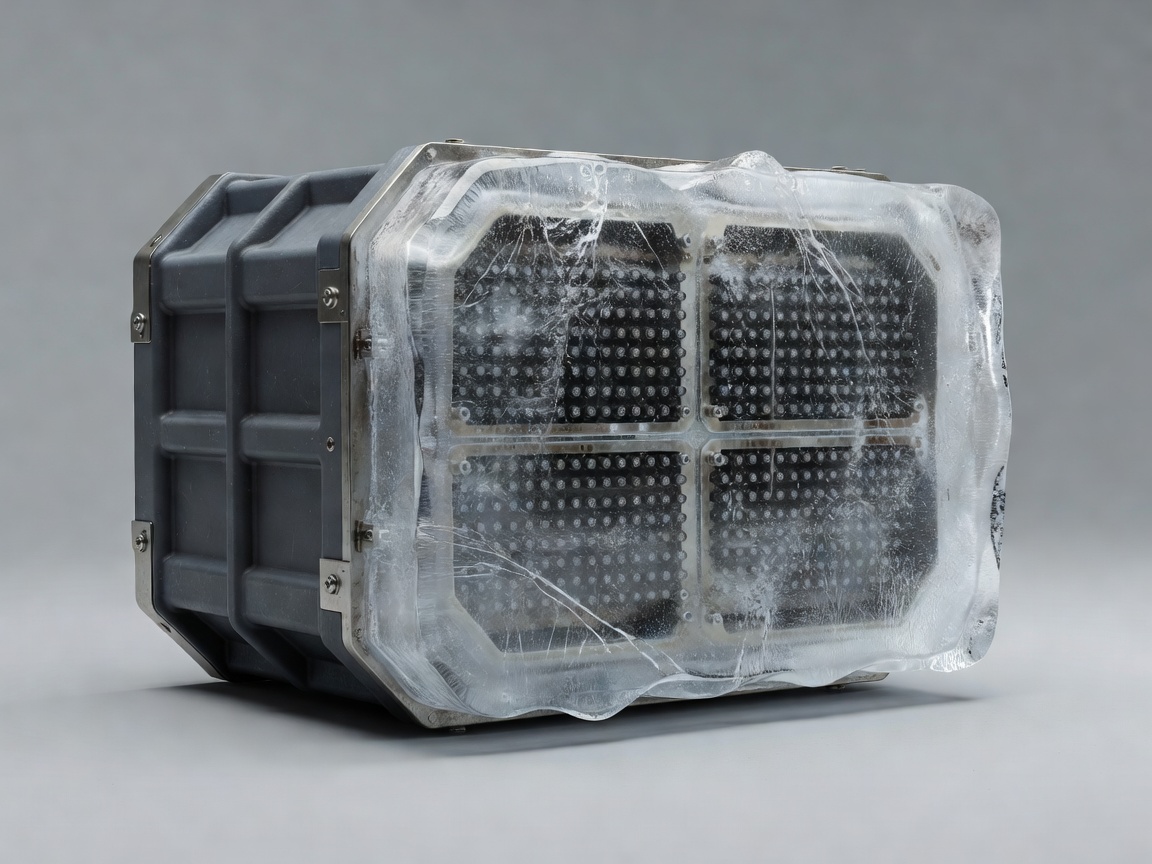
Even on an acoustically quiet hull, a boundary layer of aerated water clings to the flat bottom plates. When operating in open leads or marginal ice zones, captains lower a retractable centreboard (drop keel) 2 to 3 metres below the baseline. Housing the Acoustic Doppler Current Profilers (ADCPs, 38 kHz and 150 kHz) and scientific split-beam echosounders (EK80) inside this streamlined fin places them in undisturbed laminar flow.
When heavy ridge ramming begins, hydraulic rams retract the drop keel flush into the hull trunk within 90 seconds. Meanwhile, hull-mounted deep-water multibeam arrays (such as Kongsberg EM122 or EM304) remain protected behind acoustically transparent urethane and titanium windows engineered to withstand direct impact from submerged multi-year ice fragments.
Follow the Signal to the SensorAbout cookies Essential cookies keep this site working. Optional ones help us see what is useful. You can change your choice at any time. More about cookies